

Non-Physical Intelligence Has A Ceiling
Reasoning alone cannot predict the chaotic physical world. Without a sensory and motor interface to reality, non-physical AI will not deliver the scientific and technological breakthroughs we expect.

Disclosure: This article is for informational and entertainment purposes only and is not financial advice. The views expressed here represent the author’s personal opinion. The author holds no position, long or short, in any company named in this article. Full disclosures at the end.
In 2001 Ray Kurzweil asked what a thousand nonbiological scientists would accomplish if each were a thousand times more intelligent than a human researcher and ran a thousand times faster. A year of that work, he answered, might amount to a millennium of progress. The essay then lets those artificial scientists redesign themselves to be a million times more intelligent and a million times faster, at which point an hour of work returns a century. The argument rests on the claim that the pace of scientific and technological progress is set by the supply of reasoning alone, and that enough of it may therefore produce an explosion of both.
With AI, reasoning is becoming cheap and abundant, and within domains governed by written rules machine performance already looks superhuman. In 2025 a frontier model officially achieved a gold-medal standard at the International Mathematical Olympiad, graded under the same criteria as human contestants. Shortly after, a model from the same family reached gold-medal level at the world finals of the collegiate programming contest, solving ten of twelve problems, one of which none of the 139 human university teams present managed to solve.
A mathematical proof is checked against the axioms it builds on, and a program against the language it is written in. Both live inside systems whose rules are written down and whose answers can be tested against those rules. These human-made environments are abstract and unintuitive for most of us, which may be why mathematics and programming appear intellectually harder than an everyday skill like cooking. Performing well in mathematics and programming, however, is not the same as general intelligence.
What is intelligence in the first place? There is no general answer and no common definition. One workable framing is the ability to connect what is already known, to extrapolate or even creatively imagine what is not, and to stay aware of the unknown unknowns.
A written rule is a fixed point, exact and unmoving, and every other rule sits at a known distance from it. A ruleset is stable and in the best case closed. A closed system admits no unknown unknowns, so a powerful machine can conquer it completely. That may be why coding and mathematics fell first. Physical reality comes with no such rulebook, because physical laws hold strictly for ideal systems, and reality is almost never an ideal system.
We can measure the physical world, but a measurement is not a fixed point in the sense above. It carries an inherent error and is taken under conditions never fully recorded, so it marks a blurred region of possible states rather than one exact state. Many measurements give overlapping regions, forming a cloud rather than a grid of points. Inside the cloud a model can interpolate by connecting measurements that anchor it on all sides. Beyond it, the model can only extrapolate, imagining a continuation with nothing to anchor it, and past that edge the unknown unknowns begin. Only a new physical measurement can extend what we know, and no amount of reasoning can replace it.
A measurement records where a system was, while a forecast has to start from where it is now. The moment a state is written down it begins to age. A dataset of any size may therefore hold nothing but states the world has already left behind.
By non-physical AI I mean a model operating without an active sensory or robotic interface to reality. It is trained on a recorded body of static measurements and cannot run closed-loop experiments, which are deliberate physical interventions made to observe the response. Everything it knows arrived before the question was asked. Where its data ends, its knowledge ends.
However carefully a state is measured, some blur remains. This small range of states is entirely consistent with the recorded numbers, and in most systems that blur stays harmless because neighbouring states lead to neighbouring futures. In a chaotic system two states inside the blur, too close for the instrument to tell apart, drift apart on their own. The distance between them roughly doubles on a clock set by the system itself. The forecast stays meaningful only while the grown blur is still small compared with the range of states the system visits anyway. After enough doublings it covers that whole range and says nothing a long run average would not. A better instrument shrinks the starting blur and leaves the clock untouched. Halving the error buys one more doubling time, and every further halving buys the same fixed extension again.
Consider a real double pendulum. Its equations of motion assume rigid rods, frictionless joints and planar movement, while a physical apparatus flexes, meets bearing friction, drifts out of plane, trades energy with the surrounding air and its mounting surface, and carries the mass distribution of an imperfect manufactured object. On top of those unmodelled dynamics sits sensitive dependence on initial conditions, where a tiny difference in the release point sends the trajectories apart.
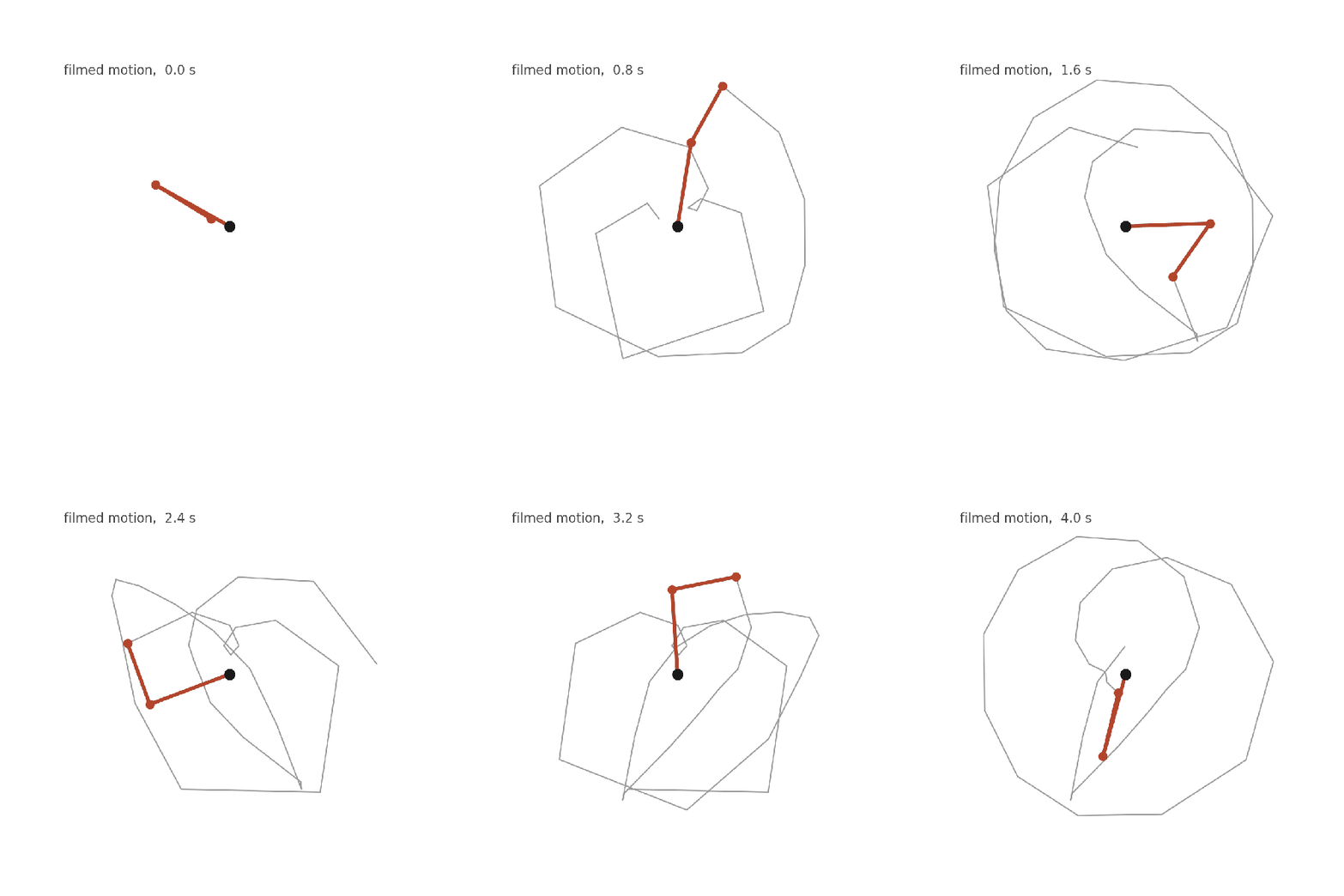
Researchers at IBM filmed a physical double pendulum with a high-speed camera at a stated 400 Hz and published the tracked marker positions. The archive holds 21 runs and 378,099 tracked frames according to the counts recovered by the analysis script used here, which at the stated rate is about forty-five seconds per run. Each frame tracks three markers, one at the fixed pivot, one at the elbow and one at the tip. The analysis assumes the camera ran at the published 400 frames per second. Later researchers argue the rate was actually 500 Hz, since at 400 Hz the total energy of the system rises in places, which a passive pendulum cannot do. I mention the dispute for completeness and keep the published 400 Hz throughout, since this is not relevant to my argument. At 500 Hz every horizon I report would be four fifths as long.
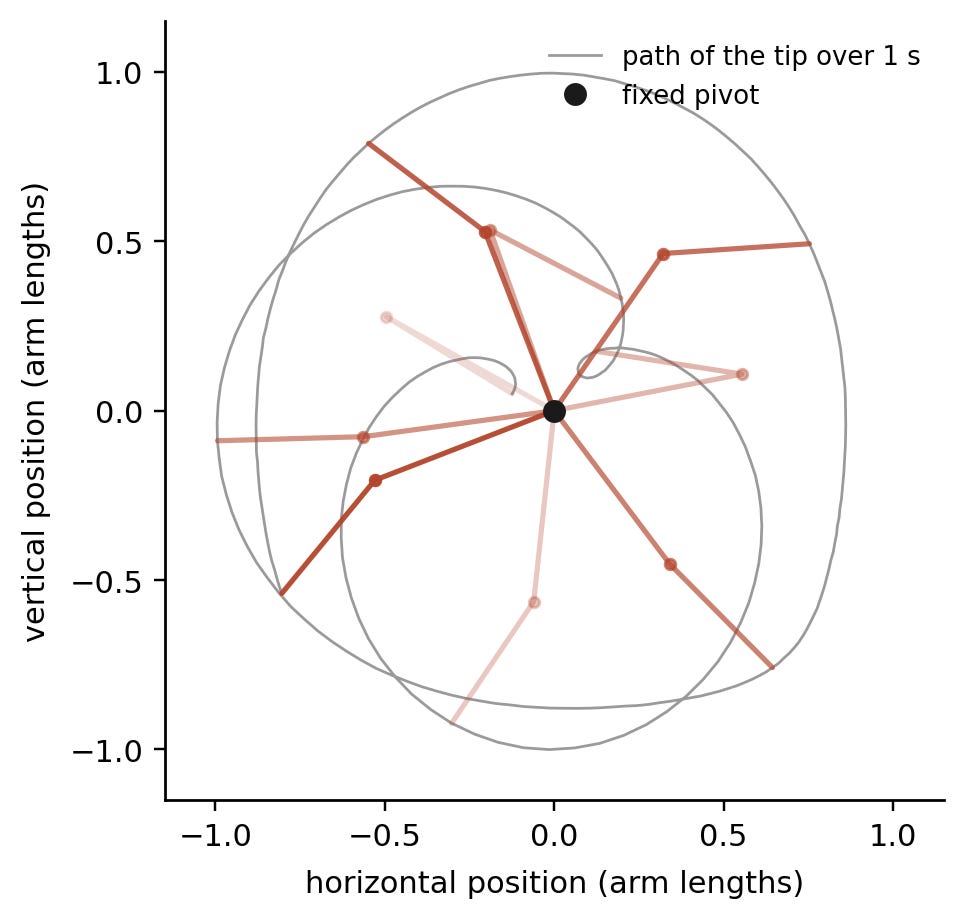
The dataset’s authors note that the device is coupled to the room it stands in through air movement and vibration of the table, and this coupling grows in importance the further ahead a forecast reaches.
I compared physics against machine learning. Both forecasters received the same starting point, the measured state of the pendulum at one instant, and ran forward with no further input. The physics forecaster is the rigid body equations with eight coefficients fitted to sixteen of the runs. The learned forecaster is a small neural network trained on the 287,768 frames those sixteen runs contain. It is a plain fully connected network with two hidden layers of 128 units and about 18,000 weights, which takes the two angles and two angular velocities and returns the state five frames later, trained on short rollouts of its own predictions. The network is deliberately small, so its result shows what a generic learned model does with the same measured state and leaves open that a larger one could do better. Neither forecaster ever sees the five held-out runs used for testing.
The equations follow the real pendulum for a median of 0.91 seconds, with per-run medians between 0.73 and 1.00 seconds across the five test runs, while the network reaches 0.50 seconds. Four seconds after the start, every forecast from both models has drifted more than a tenth of the total arm length from the filmed tip. The team behind the dataset reported a shorter reach still for their own recurrent network, which stayed on track for only a few dozen steps once it was fed its own predictions, though it started from four consecutive time steps of measured angles rather than a full measured state.
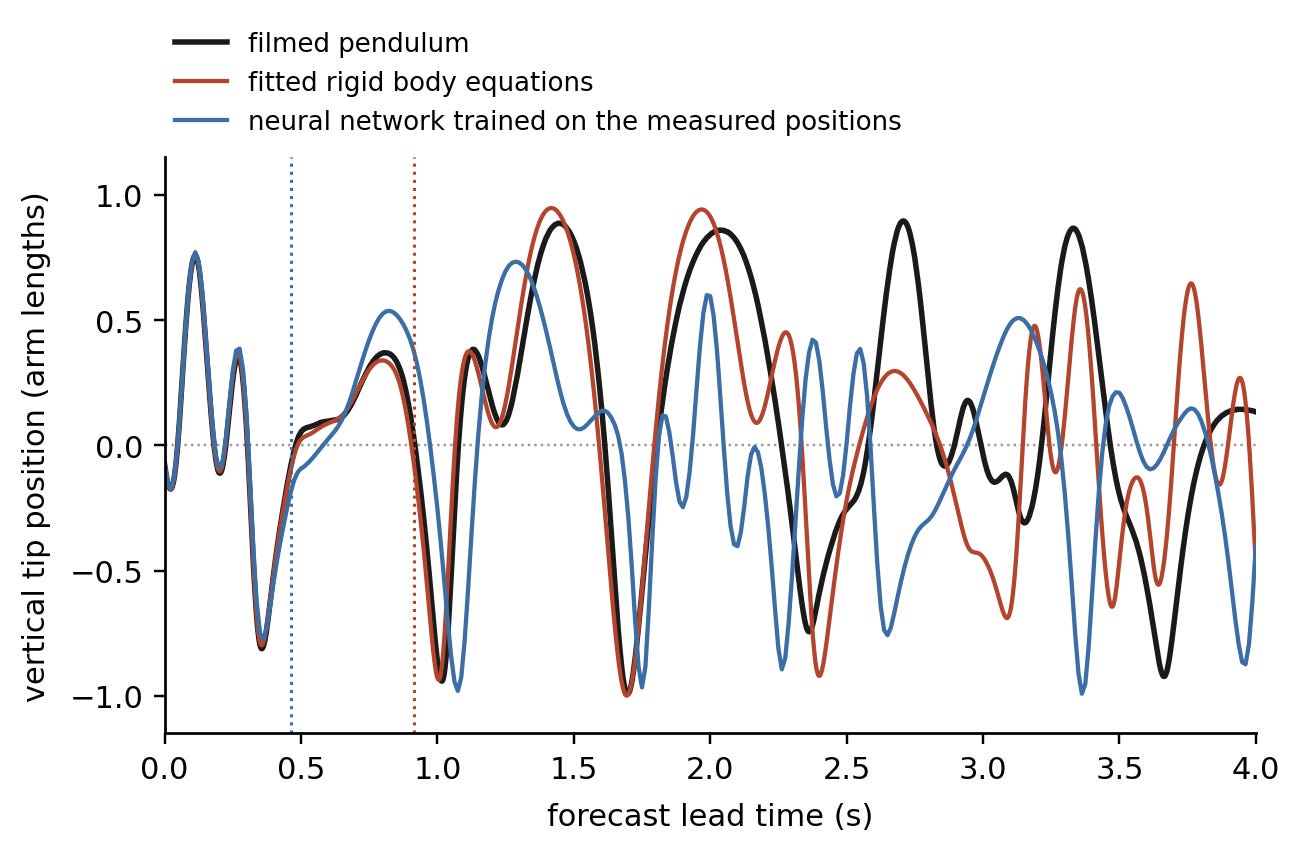
Why is forecasting this system so hard? The model may be wrong, or the starting measurement may not be precise enough. These causes can be separated by running the same equations twice. The second run starts from a twin of the measured state, shifted by an amount the size of the camera’s tracking error, so both starts are equally consistent with the film. The two runs stay within a tenth of the total arm length of each other for 1.40 seconds. That is the ceiling set by the precision of the start alone, and it should bind any forecaster working from this camera’s data. The forecast against the real object lasts just 0.91 seconds. It falls short of the ceiling because the equations do not describe that real system exactly. That missing half second is the cost of model error. Sharpening the camera tenfold might stretch the ceiling to about 2.5 seconds, and a hundredfold to about 3.5 seconds. Each tenfold gain in precision buys roughly another second of foresight.
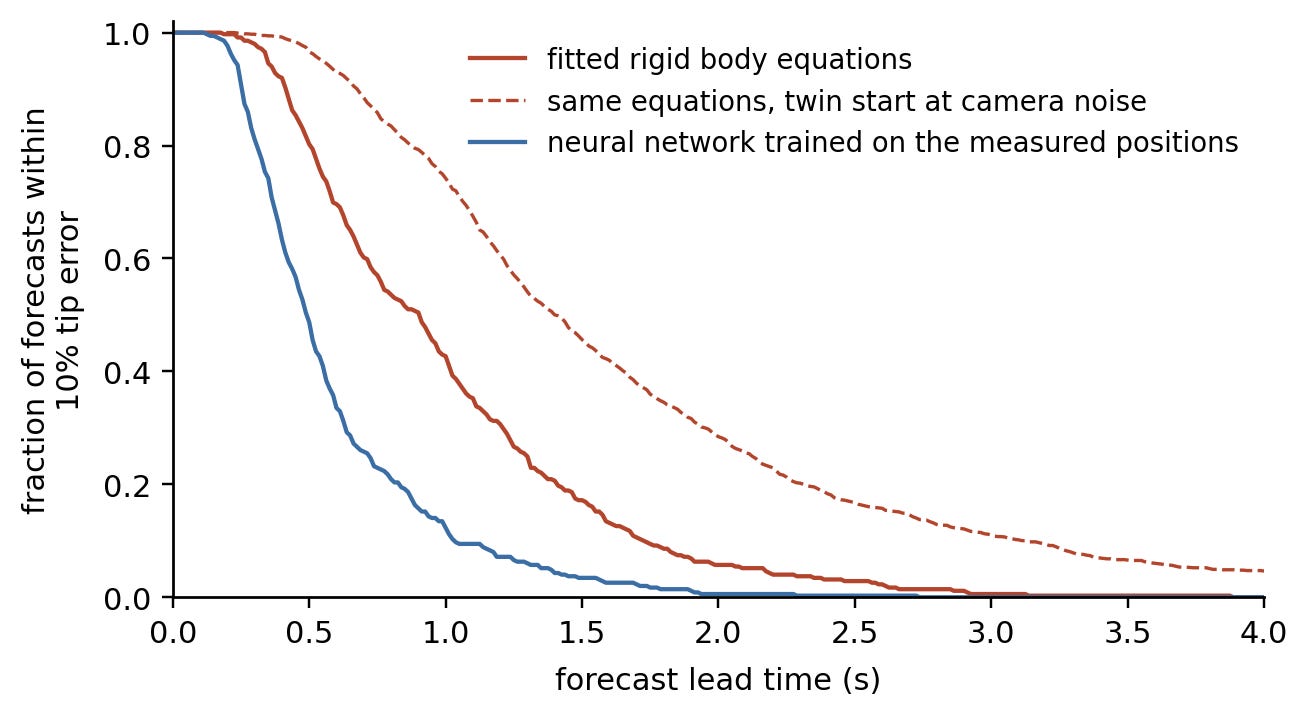
The network trained on 287,768 frames of the real object and the equations distilled those same recordings into eight numbers, yet every one of those frames captured a state the pendulum had already left. Neither forecaster ran short of recorded motion, and a larger archive may not be what would extend either one.
Chaos limits every forecaster, human or machine, so the pendulum result may initially look like a statement about chaos and nothing more. The second run tells the two limits apart, and it rests on one assumption, that the camera’s tracking error is random from frame to frame. If that error is instead correlated across frames, the shifted start carries a smaller effective error than the film does, so it diverges more slowly and inflates the apparent cost of model error. Even with that bias the ceiling appears to belong to the measurement itself, so a forecaster smarter than the fitted equations could win back at most the missing half second before reaching it.
The atmosphere is also a chaotic system, but vastly larger. Weather forecasts have nonetheless improved for decades, with predictive skill extending by roughly one day per decade. The European centre that produces them receives around 800 million observations a day, of which about 60 million quality-controlled measurements are available to its forecasting system. At each cycle the previous prediction is compared against the newly arrived measurements and the model state is updated to reflect them, which becomes the starting point of the next forecast. The machine learning models that now match or beat the equation-based system are trained on a historical record built from that same continuous measurement work. In operation they launch from the same freshly assimilated data, so their predictive power may rest entirely on an apparatus that re-measures its own starting point several times a day.
Biological intelligence works on the same tight feedback loop on a millisecond scale. Motion capture of a hunting dragonfly shows it relies on internal predictive models of its body and prey, using real-time visual feedback to adjust when the prey does something unexpected. An interception takes 200 to 500 milliseconds and succeeds in about 95 percent of cases, and a change in the prey’s path produces a steering correction thirty to seventy milliseconds later. The predictive model only needs to hold for a fraction of a second, because what it cannot anticipate is covered by the next measurement.
Forecasting asks how a known system will evolve. Engineering design asks how a system will behave once its parts are changed, and no record of the old system can answer that if the new one has never existed. To find out, an engineer has to build the change and observe the result. The engine that lifted the Saturn V took roughly 3,200 full-scale tests to develop, about 2,000 of them in the programme that chased a destructive coupling between the flame and the chamber acoustics. The layout of the injector plate was the main design variable, and each new layout was judged by firing the hardware.
Decades of physical crystallography had solved structures one at a time before a model trained on that record could predict the shapes of virtually all 200 million known proteins. Protein folding had been an open problem since the 1970s. Predictions in the field’s blind assessment hovered near 40 percent accuracy at best before the first version of the model approached 60 percent, and the second cleared the 90 percent threshold that counts as a solved structure. Structural analysis that used to take years now takes minutes. This breakthrough won Demis Hassabis and John Jumper half of the 2024 Nobel Prize in Chemistry. When a dataset already maps a domain at that density, a learned model can achieve extraordinary results.
While protein structure can now be predicted computationally, finding a better catalyst still requires running the chemistry. A mobile robot at the University of Liverpool ran that loop on its own, performing 688 experiments over eight days with nobody at the bench and choosing each new batch from the results of the batch before. It arrived at a photocatalyst mixture six times more active than the one it started from. The paper opens by noting that complexity of this kind, set by mixtures of molecular and mesoscale components, cannot yet be fully captured by atomistic simulations.
Pure reasoning models will continue to master closed, rule-bound systems. However, expecting those same non-physical models to engineer rocket engines or discover a room-temperature superconductor assumes they can bypass physical measurement in a chaotic world that does not run on written rules. Kurzweil’s artificial scientists could be made a million times faster, but their experiments will still run at the speed of physical reality. Until AI is natively paired with real-time physical measurement and closed-loop experimentation, its ability to transform the physical world will remain fundamentally capped.
Follow me on X for frequent updates (@chaotropy).
Legal Information and Disclosures
General Disclaimer: The content of this article is the personal opinion of the author and is provided for informational, educational, and entertainment purposes only. It may change without notice. Nothing here constitutes financial, legal, tax, or investment advice, and nothing here is a recommendation to buy, sell, or hold any security. Although the author is a physician, nothing here is medical advice, and no physician-patient relationship is established by reading it. Readers remain responsible for their own decisions and should consult a qualified professional where appropriate.
Position Disclosure: The author holds no beneficial long or short position, and no other economic interest, in any company named in this article, and has no business relationship with and receives no compensation from any such company. The author gives no undertaking to update this article should that change.
Accuracy and Third-Party Data: Third-party technical specifications, experimental results, and performance figures referenced in this article are linked at the point of use. While the author believes these sources to be reliable, their completeness, timeliness, or correctness cannot be guaranteed. The author assumes no liability for errors, omissions, or the results obtained from the use of this information.
Analysis and Data: The pendulum analysis was carried out by the author on the Double Pendulum Chaotic Dataset, used under the Community Data License Agreement, Sharing, Version 1.0. The dataset is cited as its authors request: A. Asseman, T. Kornuta and A. Ozcan, “Learning beyond simulated physics“, Modeling and Decision-making in the Spatiotemporal Domain Workshop, Neural Information Processing Systems, 2018. The neural network implementation, the animation, and all figures were generated by the author from that data.
Copyright: All original content of this article, including its text, figures and animation, is the property of the author and may not be copied, reproduced, or published, in whole or in part, without prior written consent, except as permitted by applicable law or the terms of the platform on which it is published. Use of that content for training machine learning or AI models is not permitted without explicit authorization. The figures and the animation were produced by the author’s own code, and any rights subsisting in them are reserved. They are not a republication of the dataset, and the author claims no rights in the underlying measured marker positions, which remain with the dataset’s rightsholders and are used under the licence named above. Nothing in this section restricts any right granted by that licence.